
A Deep Dive into the Story of Tamar and Judah
In a patriarchal society like the one in the Bible, it is easy to dismiss women as insignificant characters. Yet, in the middle of Joseph’s story, the saga of Abraham’s family pauses to give us a glimpse into a woman named Tamar. Her story is filled with disturbing, unorthodox, and even scandalous actions—yet it made its way into Scripture and continues to be told thousands of years later.
Who is Tamar? She is a foreign woman who, against all odds, was granted a chapter in the sacred story of Abraham’s descendants. Does she deserve more recognition? Should she be remembered alongside strong, independent biblical women such as Esther and Ruth? Some may find her story questionable, but if we read carefully, we see a woman who did what she had to do in order to survive. Perhaps, if we look closely, we will realize that Tamar’s story mirrors our own.
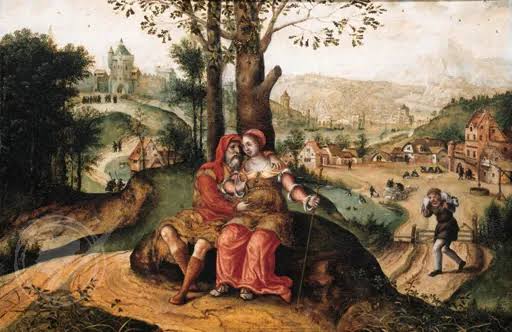
The family of Abraham is no stranger to tragedy, deception, and scandal, and Tamar’s story fits right into that pattern. What makes her story striking is the way it suddenly interrupts the Joseph narrative. Genesis 37 ends with Joseph being sold into slavery in Egypt, but Genesis 38 abruptly shifts. Unlike Joseph, who was torn from his family against his will, Judah chose to leave. His departure seems natural—after all, it is common for adults to leave their parents and make their own way. But his choice to live among the Canaanites marked a turning point. He did not merely interact with them; he fully immersed himself in their world. He even married a Canaanite woman (Genesis 38:2). This peaceful picture of Judah’s family stands in contrast to the household of Jacob, from which Judah separated himself (Roop, 249).
I. Tragedy, Deception, and Vulnerability
Tamar, whose name itself suggests Canaanite origins, soon became connected to Judah’s family. Although Tamar’s faith is not mentioned in the Bible, the story suggests she is a faithful woman. It was not her fault that she was married into the Abrahamic family and given a wicked husband. Because of her marriage to Er, she was now bound to follow the family’s traditions. We do not know how wicked Er was to deserve to die (Genesis 38:7), but unlike today, in that time the death of a husband did not bring freedom—it brought vulnerability. In that society, widowhood was not only tragic but also dangerous. A woman without sons had no legal protection, no inheritance, and no social security.
Judah, following the custom of levirate marriage (later codified in Deuteronomy 25), instructed his second son, Onan, to fulfill his duty by marrying Tamar and producing an heir for his deceased brother. This custom was designed to protect widows and continue a man’s family line. On the surface, Judah’s command seemed compassionate. But Onan resisted (Genesis 38:9–10). By secretly refusing to fulfill the levirate responsibility, Onan sought to protect his own access to the family inheritance (Roop, 250)—a decision that ultimately led to his own demise.
Once again, Tamar bore the consequences. Both of her husbands were dead, and though she had done nothing wrong, she was now twice widowed. One can imagine the whispers: Was she cursed? Like Sarah in the intertestamental book of Tobit (Tobit 3:8), Tamar may have been seen as unlucky or even deadly.
If there was anyone to blame for this chaos, it was Judah for raising wicked sons. Tamar’s only “sin” was marrying into this dysfunctional family. She was faithful enough to follow her father-in-law’s instructions to wait for his third son, Shelah, to grow up. She stayed unmarried and waited for Judah to fulfill his promise. But Tamar knew, at some point, she needed to act. She could not wait any longer. She would not be looked down upon by these men. She would not be used and discarded like an object. Tamar was wiser than they thought.
II. Strategy, Justice, and Redemption
This time, Tamar decided to take what she deserved through deception. Sound familiar? Deception is a recurring theme in Abraham’s family—from Abraham and Sarah’s own schemes to Rebekah’s deception of Isaac on behalf of Jacob (Genesis 27). Tamar, like Rebekah, acted decisively within a patriarchal world to secure justice when men failed to do so.
Judah, for his part, was not merely a victim. The story implies that he was ashamed of his encounter with the supposed prostitute, since he had to send someone to pay her and was too embarrassed to go himself. When Judah’s friend searched for the woman, he referred to her as a “temple prostitute.” This designation raises the possibility that Judah had sought to increase the yield of his flocks through a Canaanite fertility ritual (Roop, 251).
Tamar took a great risk by deceiving her father-in-law. She used what power she had—her beauty, her intelligence, and her womb. She seized the limited opportunity before her without hesitation. Tamar was an extraordinary woman: organized, strategic, and perceptive. She knew Judah would never let her marry Shelah. Instead of pleading, she devised a plan. Knowing Judah’s weakness, she prepared evidence to protect herself. The signet, cord, and staff she took were items of personal identification—like taking Judah’s passport or driver’s license (Genesis 38:18). Her attention to detail shows remarkable foresight. After the encounter, she quickly changed her disguise from a prostitute back to a widow to avoid suspicion (Genesis 38:19). These actions could only be carried out by a woman who planned carefully and acted with courage.
When Judah discovered Tamar was pregnant, he initially demanded she be punished. Yet, when confronted with his own items, he immediately recognized his wrongdoing: “She is more righteous than I” (Genesis 38:26). This powerful patriarch not only pardoned Tamar but also publicly acknowledged his guilt for failing to uphold his levirate duty.
“She is more righteous than I.” — Judah (Genesis 38:26)
This seemingly disturbing story of Tamar and Judah may unsettle readers when viewed through modern moral values, but it seems God allowed this story to endure for a reason. When Judah declared Tamar “more righteous,” the Hebrew term ṣĕdāqâ (sedaqah) was used. In Hebrew narratives, sedaqah is not defined narrowly by abstract moral or religious standards, as our English word “righteousness” often implies. Rather, it describes actions that promote vitality and right relationships within a specific context (Roop, 253).
Tamar’s bold actions restored Judah’s family line, which was in danger of dying out. By giving birth to twins—Perez and Zerah—she secured the continuation of Judah’s descendants. Perez, in fact, became one of the most important ancestors in Israel’s history. The book of Ruth recalls his legacy: “Perez was the father of Hezron, Hezron the father of Ram… Salmon the father of Boaz, Boaz the father of Obed, Obed the father of Jesse, and Jesse the father of David” (Ruth 4:18–22). The Gospel of Matthew includes Tamar by name in Jesus’ genealogy: “Judah the father of Perez and Zerah, whose mother was Tamar” (Matthew 1:3). Out of all the women who could have been mentioned, Tamar was chosen as one of the few explicitly remembered in the Messiah’s lineage.
But this is also Judah’s story. Though he failed Tamar, he did something rare for a patriarchal leader: he confessed his wrong and acknowledged her righteousness. This moment of humility foreshadows the Judah we later meet in Genesis 44, who offers his own life in place of Benjamin’s to save his family. Judah’s descendants would carry his name—becoming the Jews—and from his line came David, and ultimately, Jesus.
The story of Tamar and Judah is therefore not merely a tale of scandal. It is a story of survival, justice, and the surprising ways God works through flawed people. Tamar, an outsider, became essential to God’s plan. Judah, a man with weaknesses, became a leader because he was willing to admit his faults. Together, their story points to the truth that righteousness in God’s eyes is not always about perfection, but about restoring broken relationships and continuing the promise of life.
So, does Tamar deserve recognition alongside women like Esther and Ruth? Absolutely. Her courage, strategy, and determination to secure justice for herself ensured the continuation of a family line that would bless the entire world. Tamar’s story reminds us that even in the darkest circumstances, God can work through unexpected people to bring about redemption. And perhaps, when we see her story in that light, we will recognize parts of our own struggles, courage, and resilience reflected in Tamar’s journey.
References
Eugene F. Roop, Genesis: Believers Church Bible Commentary (MennoMedia, 1987)