The Price of Comfort
What happens to a radical movement when it becomes too comfortable?
Imagine a movement born out of persecution and marginalization, eventually becoming accepted within a wealthy and comfortable society. That is exactly what happened to the Dutch Mennonites.
The Anabaptist movement began in 1525, and within a century, Anabaptists in the Netherlands were already living very differently from their ancestors. After gaining independence from Spanish Catholic rule, the Netherlands became a more tolerant and progressive society. This gave early Anabaptists and Mennonites greater freedom to practice their faith while also participating in their country's growing economy.
As the Netherlands became one of the wealthiest nations in Europe, Thieleman van Braght became concerned that many Mennonites were forgetting their past and becoming too attached to wealth and possessions. Van Braght's vision for his book was to renew the faith of what he saw as spiritually "lukewarm" Dutch Mennonites.
Thieleman van Braght was born in Dordrecht, Netherlands, in 1625. He was the son of a cloth merchant and later entered the same profession. He was baptized into the Flemish branch of the Mennonite Church at the age of nineteen and became an elder at twenty-six, serving in that role until his death.
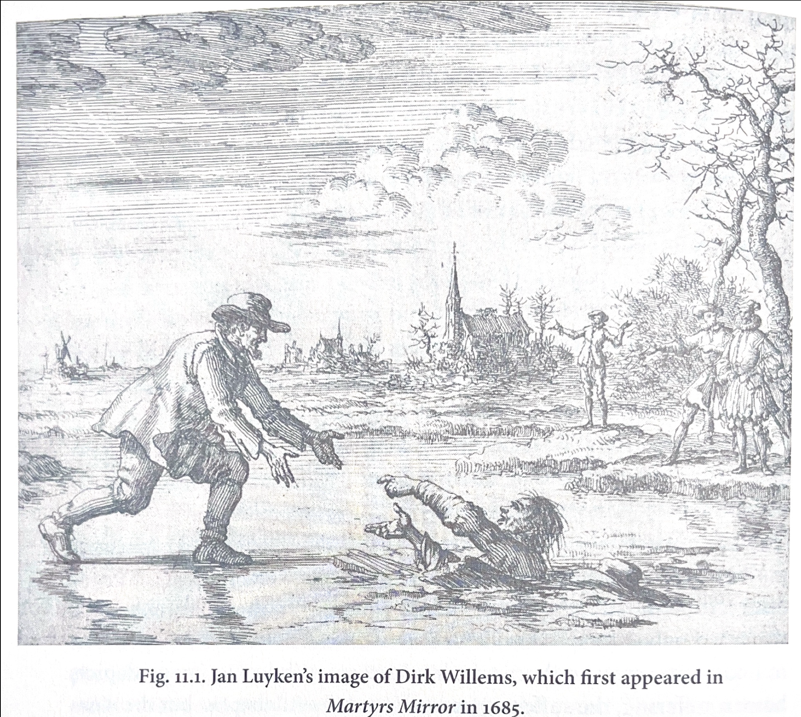
Jan Luyken's classic illustrations later came to visually define the work's historical gravitas.
“Possessions have increased, but in the soul there is leanness.”
Thieleman van Braght, 1659
Despite struggling with chronic poor health, he completed his book while recovering from a severe illness. He died in 1664 at the age of thirty-nine. His original work was over 1,500 pages long. Advertisements for the book claimed it contained the testimonies of more than 4,011 people who suffered martyrdom.
However, this figure includes both Reformation-era Anabaptists and earlier Christian martyrs, including Jesus' disciples. Van Braght's purpose was to establish what became known as the "succession doctrine"—the belief that faithful Christians had existed throughout history, even outside the established church. Of the accounts included, more than 2,500 focus on Anabaptists who were martyred in Europe during the sixteenth and early seventeenth centuries.
The Evolution of a Masterpiece
The full title of the book is: The Bloody Theater of the Baptism-Minded and Defenseless Christians, Who for the Testimony of Jesus Their Savior Have Suffered and Were Slain, from the Time of Christ to These Our Last Times. Along with a Description of Holy Baptism and Other Articles of Worship Observed by Them Through All Ages.
Today, it is universally known as Martyrs Mirror. Contemporary artists continue to wrestle with these texts, adapting classic nonresistance narratives to face new socio-political pressures and shifting definitions of national loyalty.
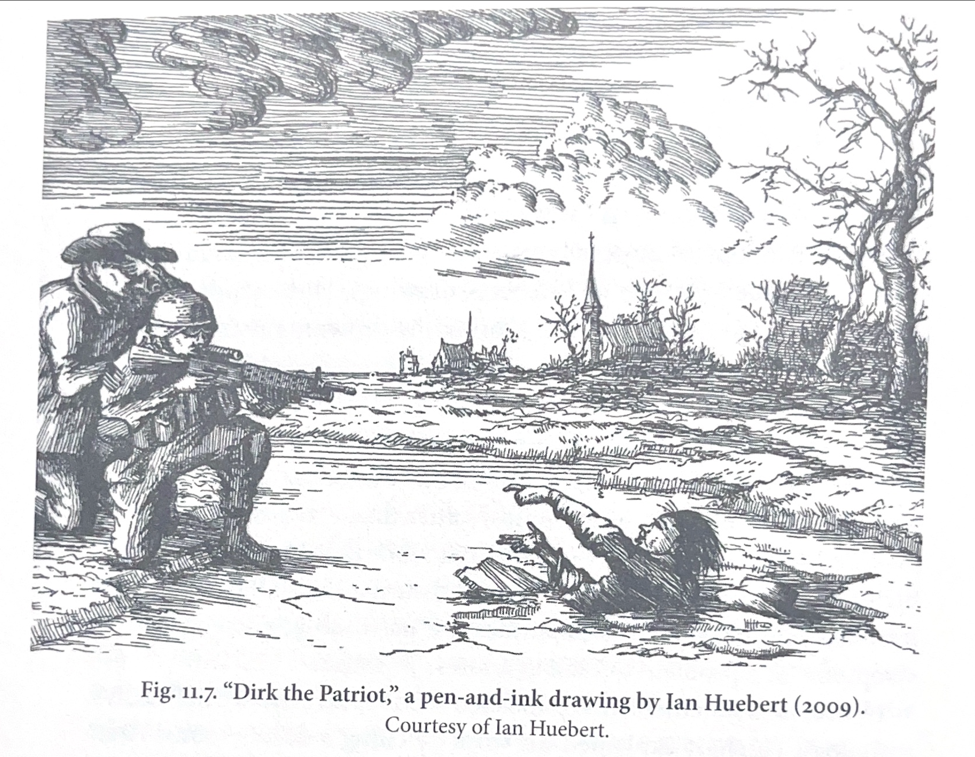
Fig. 11.7. "Dirk the Patriot," a pen-and-ink drawing by Ian Huebert (2009), contextualizing subversion and defense within modern frameworks.
Chronology of the Mirror
A small, anonymous predecessor martyrology published to be easily hidden away in a coat pocket to escape raw state persecution.
Hans de Ries publishes Martyrs Mirror, or the Defense of Defenseless Christians, providing the critical foundation for Van Braght's expansiveness.
Van Braght completes his 1,500-page master volume detailing centuries of continuous faith and resistance.
Artist Jan Luyken adds 104 stunning copper engravings, prompting publishers to raise the title "Martyrs Mirror" in scale on the layout cover.
Amid geopolitical friction and the "flames of war" in colonial America, North American immigrants demand a German translation to protect the doctrine of nonresistance.
Translated by Joseph F. Sohn and published by John F. Funk in Elkhart, Indiana, establishing the book as an foundational heirloom across global Amish and Mennonite households.
An Antidote to Assimilation
Different Anabaptist groups came to regard the book as one of their most important spiritual resources. It was used in sermons, Sunday school classes, and family devotions. For Van Braght, the true church was always "a suffering church."
Perhaps the most famous figure in Martyrs Mirror is Dirk Willems. Modern revisions, such as Ian Huebert's visual commentary, demonstrate how modern geopolitical alignment and state structures challenge our historic perceptions of peace and duty.
The irony of Martyrs Mirror remains striking: it tells stories of sixteenth-century believers who suffered greatly for their faith, yet it was often read by their wealthy and comfortable descendants who had never experienced such persecution themselves.