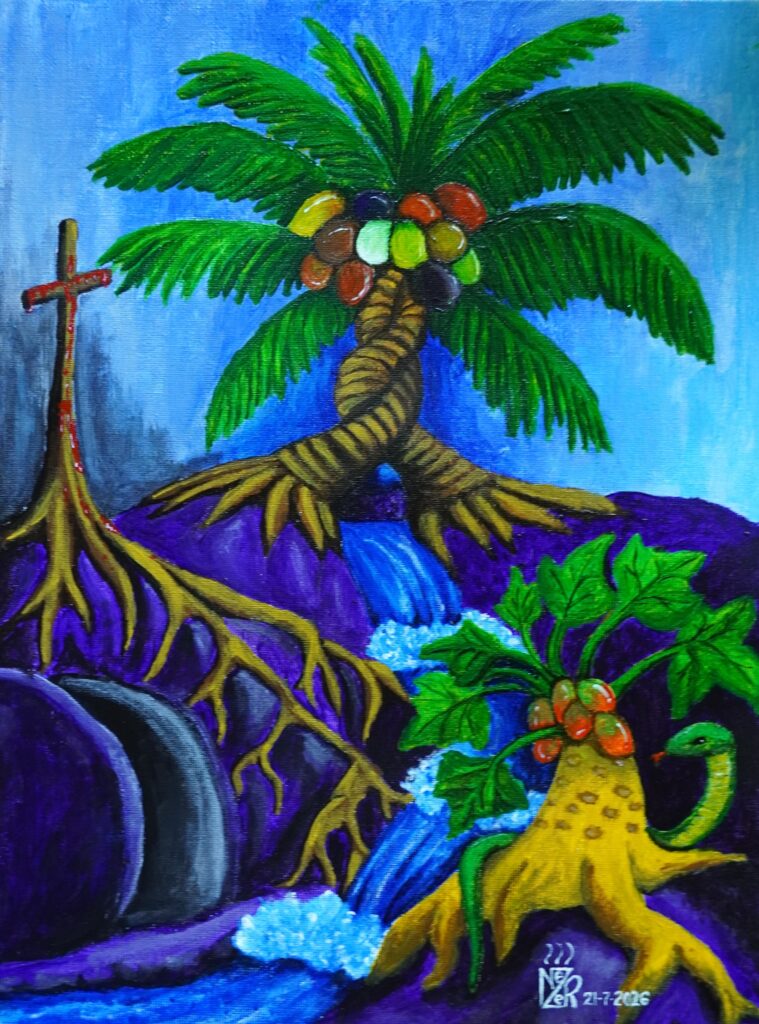
A Shared Flame: Reimagining the Future of Anabaptist Missiology
I. The Face of Global Anabaptism Today
I was inspired to create an illustration of what the current movement of Anabaptism in the world looks like if it were turned into an image. According to data from Mennonite World Conference, the majority of the world’s Anabaptist-affiliated churches are now in the Global South, with Africa and Asia representing a significant portion of that population. Ethiopia alone accounts for a substantial share of the global Anabaptist population.
Looking at this data, if we were to create an image of what a typical Anabaptist might look like today, it might be a middle-aged woman from Africa. This image stayed with me, and it made me ask myself: What about the missional church? If we were to illustrate what the missional church looks like today, what would that image look like?
II. The Canvas: Four Figures and a Flame
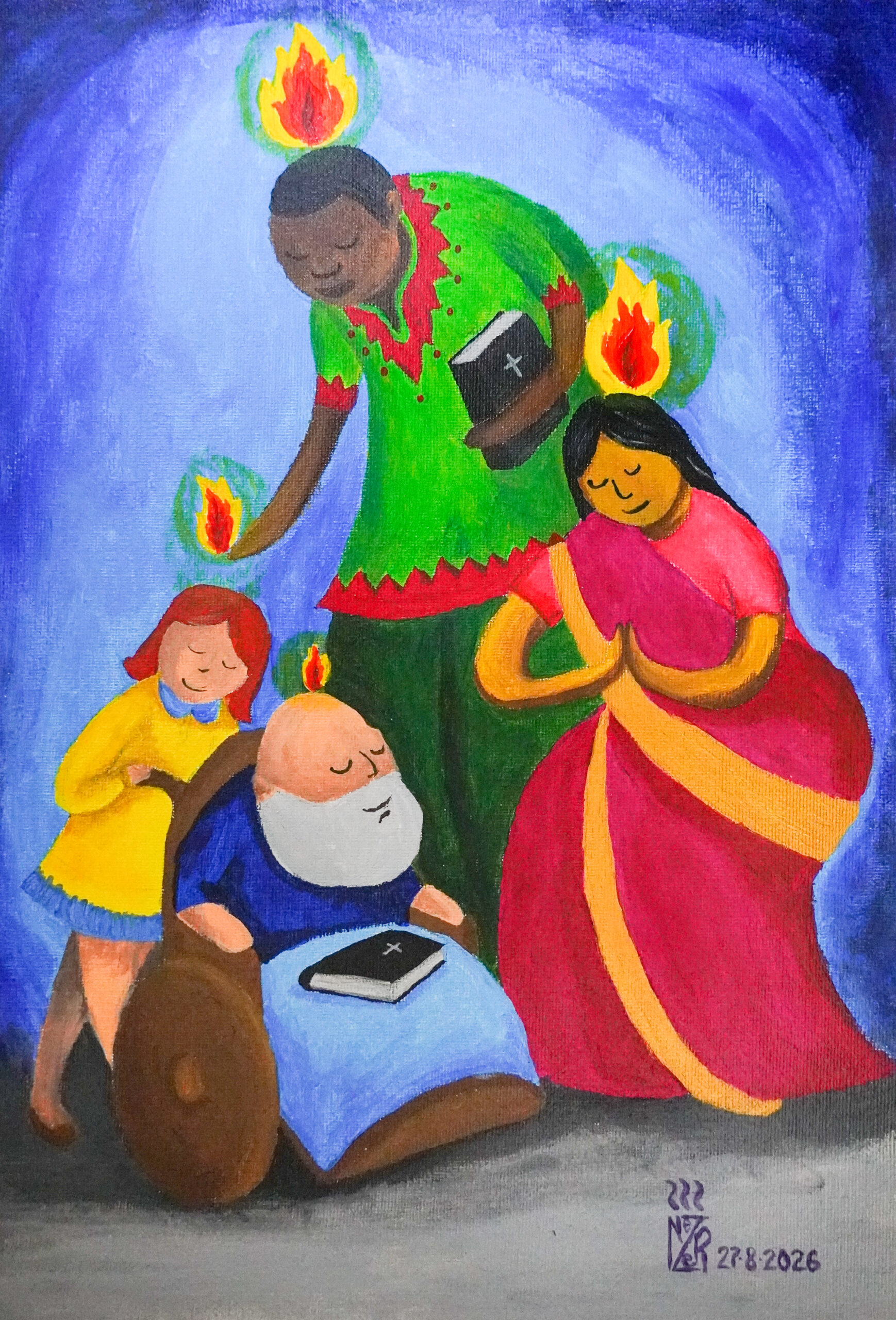
On a canvas board, I painted an image using acrylic paint to illustrate what I personally feel is the current state of missiology within the Anabaptist community. The image contains four people. The two larger figures are from the Global South: an African man and a South Asian woman. The two smaller figures appear to be from the Global North, represented as Caucasian. One of them is an older person in a wheelchair being pushed by a younger woman, who could be his granddaughter.
“The people of the Global South are not simply recipients of the mission of the Global North anymore. They are also becoming partners, teachers, missionaries, and sources of renewed energy for the church in the Global North.”
As you look at the image, the older man in the wheelchair and the young woman appear to be moving toward the two people from Africa and Asia, who are welcoming them. There is also an element of flame in the image, representing enlightenment, passion, or perhaps the flame of evangelism. You can also notice a Bible being held by both the African man and the older man in the wheelchair.
III. Shifting Energies and Shared Passions
Historically, the Global North, having greater access to resources, has often taken the leading role in sending missionaries to different parts of the world. As someone who also comes from the Global South, I am genuinely thankful for the ways missionaries from the Global North have contributed to the growth of the church in many parts of the world.
However, with the shrinking of many churches in the Global North and the declining interest among younger generations in traditional church involvement, I wonder if some of the missionary energy from the Global North has also become less “fiery.” This is represented in my painting by the older person in the wheelchair carrying a Bible. His work and contribution are valuable and appreciated, but the flame above his head is becoming dimmer as time goes by. The wheelchair does not necessarily represent weakness, but rather the reality that the older generation has carried much of the work of the church and mission for a long time, and now the church needs a new generation to continue the journey.
The two larger figures represent the Global South, which has grown significantly in the global Anabaptist population. They also have larger flames above their heads, representing passion for evangelism, church growth, and participation in the mission of the church. In this sense, they are becoming the new missionaries—not only within their own communities but also to the Global North.
IV. Multidirectional Mission: A Vision of Hope
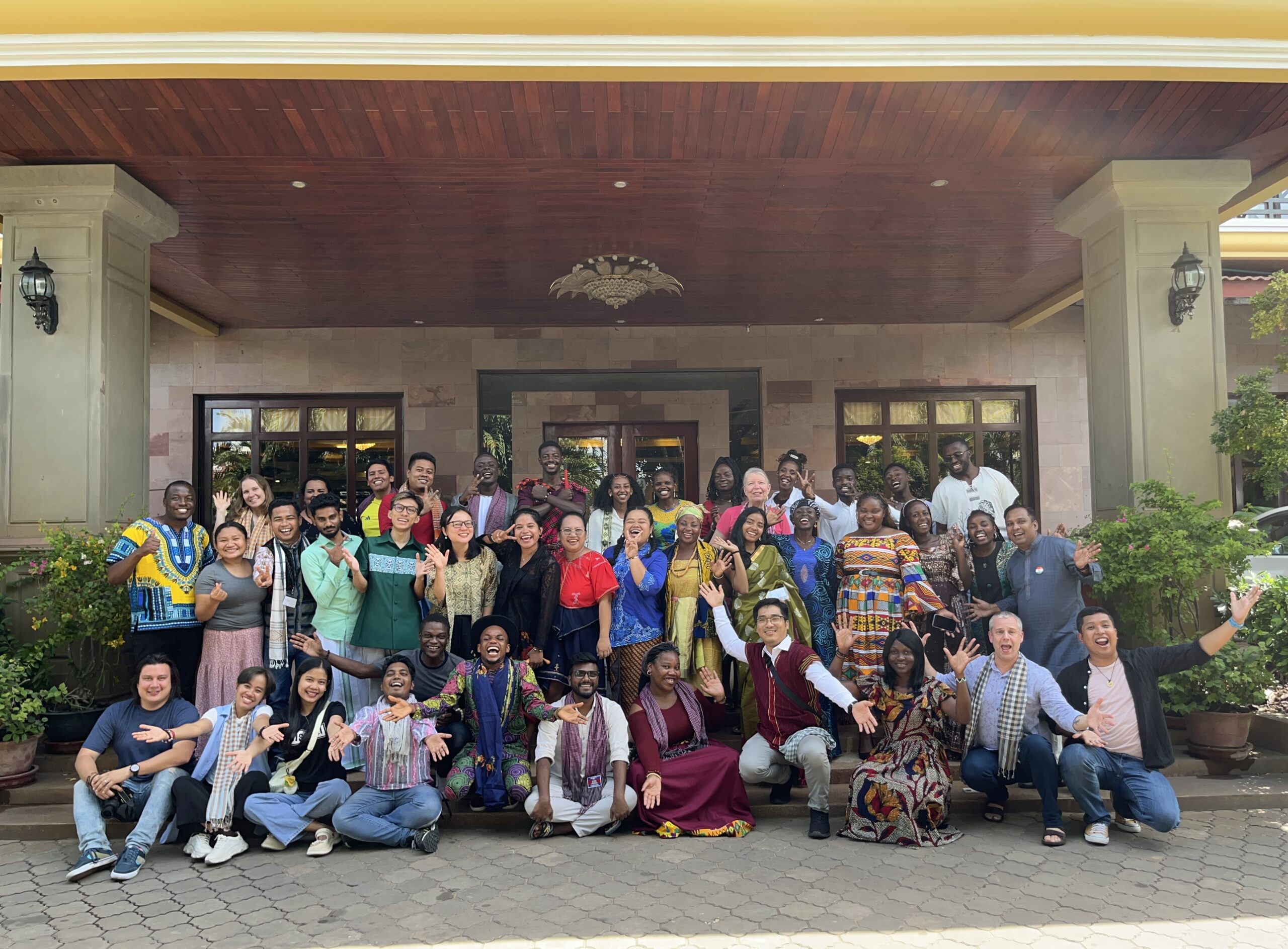
We can already see some of this happening through diaspora churches emerging in North America and Europe, often fueled by immigrant communities. Exchange programs for young people, such as YAMEN (Young Anabaptist Mennonite Exchange Network) of MCC, also demonstrate how young people from the Global South are increasingly engaging in cross-cultural experiences within Anabaptist communities around the world.
This is represented in my painting by the African man sharing some of his flame with the young woman. For me, this represents the possibility of a cross-cultural exchange of experience, faith, passion, and vision. I imagine this as a new dynamic for the Anabaptist mission. Mission will no longer be understood as moving in only one direction, from the Global North to the Global South.
Instead, the movement of mission can become mutual and multidirectional. The fire of evangelism and discipleship can move in both directions. Ultimately, I see this painting as an image of hope for the global Anabaptist church: a church in which mission is no longer defined by who has the most resources, but by a shared calling to follow Christ, learn from one another, and participate together in God’s mission.
References & Context
Mennonite World Conference, World Directory & Membership Data
Mennonite Central Committee (MCC), YAMEN Program Orientation 2024 (Cambodia)