
Spirituality on Sacred Images
Recovering the visual theology of Hildegard of Bingen and the role of sacred imagery in Christian formation.
Introduction
Christian spirituality has long been expressed through both words and images. Throughout the history of the Church, sacred art has served not only as decoration but also as a way of teaching, worshiping, and nurturing spiritual growth.
Before most people could read, visual images communicated biblical stories and theological truths, helping believers understand and experience the Christian faith. Even after literacy became more common, sacred art continued to shape Christian imagination by inviting people to reflect on God’s presence through symbols, colors, and visual narratives. Today, however, the visual imagination of many Christians is influenced mainly by Renaissance art, while earlier medieval traditions of visual theology receive much less attention.
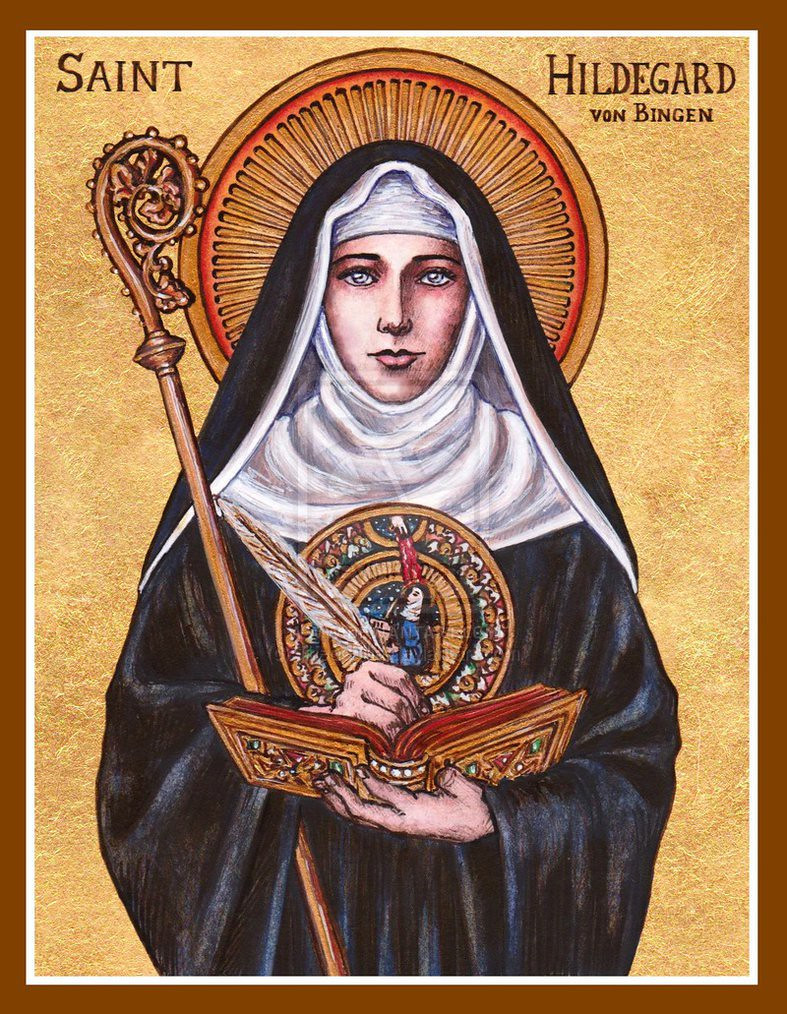
One important but often overlooked example of medieval visual spirituality is Scivias, the visionary work of the twelfth-century Benedictine abbess, mystic, theologian, composer, and artist Hildegard of Bingen. Written between 1141 and 1151, Scivias, meaning “Know the Ways,” records Hildegard’s visions alongside vivid symbolic images that convey deep theological truths. These images are much more than illustrations; they are part of the text. They function as visual theology, inviting readers to reflect on God’s work in creation, salvation, the Church, and the human soul. Rather than communicating theology only through written explanations, Hildegard uses images to engage the imagination, emotions, and senses, encouraging readers to encounter God’s truth in a more holistic way.
Despite this rich visual tradition, modern Christian spirituality often emphasizes reading, preaching, doctrine, and intellectual understanding. While these practices remain essential, they can unintentionally reduce the role of visual contemplation and embodied experience in spiritual formation. As a result, many Christians are less familiar with forms of visual theology that once played an important role in the life of the Church. This creates a gap between contemporary Christian practice and the medieval tradition of contemplative spirituality. Recovering this forgotten tradition can offer valuable insights to believers seeking a deeper, more integrated relationship with God.
This study addresses that gap by examining the sacred images in Scivias as resources for Christian spirituality. Rather than treating the illustrations as secondary to Hildegard’s written visions, this paper argues that they should be understood as expressions of visual theology. Through carefully crafted symbols and visual metaphors, these images communicate theological truths while encouraging contemplation, imagination, and embodied faith. They invite believers not only to understand theology intellectually but also to experience it through reflection, meditation, and active participation of the imagination.
Guided by this perspective, this paper explores several questions: How do the sacred images in Scivias function as tools for spiritual formation? In what ways do Hildegard’s images communicate theological truths through visual symbolism? How do these images encourage contemplation, imagination, and embodied faith? Finally, what insights can contemporary Christians gain from this medieval visual tradition? By examining selected images from Scivias within their historical and theological context, this paper argues that Hildegard’s visual theology remains relevant for the Church today. Recovering her approach to sacred imagery can help contemporary Christians rediscover a more holistic and contemplative spirituality that complements Scripture, theology, and everyday Christian life.
Historical Background
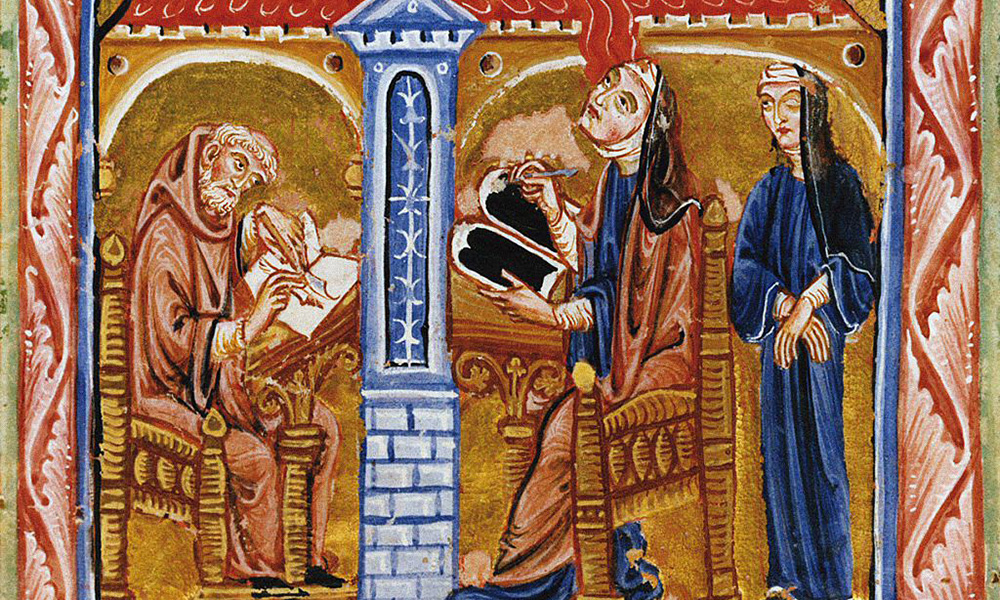
Hildegard of Bingen (1098–1179), often called the “Sibyl of the Rhine,” was one of the most remarkable Christian figures of the twelfth century. She was a Benedictine abbess, mystic, theologian, composer, physician, and writer whose influence extended far beyond the monastery. Born into a noble family in the Rhineland as the tenth child, Hildegard was dedicated to God at an early age and entrusted to the care of the anchoress Jutta of Sponheim when she was eight. She spent nearly forty years at the monastery of Disibodenberg, where she lived first as a recluse and later became abbess after Jutta’s death in 1136. Although Hildegard often described herself as “unlearned” to emphasize that her visions came from God rather than from her own knowledge, she was an intelligent and respected thinker who corresponded with four popes and two emperors.
Hildegard lived during a time of major political and religious change, often described as the twelfth-century reformation. One of the defining events of this period was the Investiture Struggle, a conflict between the papacy and the Holy Roman Empire over the authority to appoint church leaders. At the same time, the Church faced challenges from movements such as the Cathars, whose teachings challenged key Christian doctrines on creation and the sacraments. Seeing corruption within the Church, Hildegard became a prophetic voice who preached publicly and called both clergy and laypeople to repentance and renewal.
The spirituality of Hildegard’s time was deeply rooted in monastic life. Monasteries were viewed as schools of virtue where believers learned to grow in holiness through prayer, discipline, and worship. Faith was understood not only through study but also through lived experience and visual expression. The created world was seen as a reflection of God’s presence, allowing believers to recognize spiritual truths through the natural world. A central idea in Hildegard’s theology was viriditas, meaning vitality or greenness, which described the divine life that sustains all creation. She believed that spiritual growth required believers to put on the “armor of light” by practicing the virtues, which she often portrayed as living, powerful figures who helped guide people toward the “Living Light” of God.
In 1141, when Hildegard was 42, she had a vision that changed the course of her life. She described a brilliant, heavenly light filling her mind as a divine voice commanded, “Write what you see and hear!” This experience marked the beginning of Scivias, an abbreviation of the Latin phrase “Scito vias Domini,” meaning “Know the Ways of the Lord.” The work records the visions she received and explains their theological meaning.
Scivias is carefully organized into three parts in honor of the Trinity and contains twenty-six visions that tell the story of salvation, from creation and the fall of the angels to the final judgment. The work gained widespread recognition after Pope Eugene III heard portions of the manuscript read at the Synod of Trier (1147–1148) and officially approved Hildegard’s visions for publication. Throughout Scivias, Hildegard presents vivid symbolic images, including the universe as a cosmic egg and the Church as the Mother of Believers. These images were not intended simply to illustrate her visions. Instead, they communicated theological truths in ways that invited readers to contemplate God’s work in creation, redemption, and the life of the Church.
Understanding this historical and spiritual context helps explain why visual imagery became such an important part of Hildegard’s theology and why Scivias continues to offer valuable insights for Christian spirituality today.
Visual Theology and Spiritual Formation
Hildegard von Bingen’s Scivias provides an important example of how visual theology shaped spiritual formation during the Middle Ages. Rather than using images simply as decorations, Hildegard treated them as a way of knowing God. Her visions invited readers not only to see but also to understand, reflect, and experience God’s truth. In Scivias, images become a language through which theology is communicated, engaging both the mind and the imagination.
The symbols throughout Scivias translate divine mysteries into images that people can understand and contemplate. Hildegard fills her visions with symbols that reveal God’s character and work in creation. One of her best-known images is the universe as a cosmic egg. In this vision, the outer layer of shining fire represents God’s power holding creation together, while the “pure ether” symbolizes belief. Colors also carry theological meaning. Sapphire blue represents the Son, while golden red symbolizes the Holy Spirit. These visual symbols bridge the gap between the visible world and the invisible realities of faith. Rather than explaining theology only through words, Hildegard uses images to help believers imagine and experience spiritual truths. As Morton Kelsey suggests, sacred images communicate realities that cannot always be fully expressed through logical or scientific language.
Hildegard also used Scivias as a tool for teaching and spiritual formation within her monastic community. The book became a guide that helped her nuns grow in faith through prayer, study, and meditation. Instead of presenting virtues as abstract moral ideas, Hildegard portrays them as radiant female figures who actively encourage believers in their spiritual journey. This approach made theological concepts easier to understand and remember. Similar teaching methods appeared in other medieval works, such as the Speculum virginum, where the Jesse Tree was used to illustrate spiritual growth and renewal. Through these visual images, Hildegard helped women deepen their understanding of God, even when educational opportunities for women were often limited.
Visual contemplation was an important spiritual practice in Hildegard’s world. One example is ruminatio, often described as “chewing on the cud” of Scripture or a sacred image. Instead of quickly reading a text, believers spent time slowly reflecting on it until its meaning became part of their lives. Hildegard encouraged the same approach with her visions and songs. Listeners were invited to imagine the vivid colors, symbols, and scenes she described so that the images would shape both their understanding and their spiritual lives. Through this process, believers could imagine themselves in biblical events, such as Christ’s birth or crucifixion, making Scripture more personal and spiritually meaningful. The images became mirrors that helped believers examine their own lives and draw closer to God.
For Hildegard, spiritual formation involved the whole person. She described the body as the “tent” that supports the soul’s life. Seeing was not limited to physical sight but involved the entire person, including the emotions, imagination, memory, and body. David Morgan describes this as haptic visuality, in which seeing also includes a sense of touch and an embodied experience. Sacred images, therefore, become places of encounter rather than objects to be observed from a distance. Through practices such as kneeling, prayer, singing, silence, and imaginative meditation, believers actively participated in what they saw. In this way, Hildegard understood spiritual growth as the work of the whole person, where body, mind, imagination, emotions, and the Holy Spirit work together to draw believers into the living presence of God.
Analysis of Selected Images from Scivias
Hildegard von Bingen’s Scivias demonstrates how visual images can convey theological truths that words alone cannot. Rather than functioning as simple illustrations, the images invite believers to contemplate God’s work in creation, redemption, and the life of the Church. Through symbolism, Hildegard connects the visible world with invisible spiritual realities, allowing readers to engage both their minds and their imaginations. The following examples show how these sacred images serve as visual theology and encourage spiritual formation.
The Cosmic Egg: Creation and Divine Order

One of the most recognizable images in Scivias is the Cosmic Egg, found in the third vision of the first part. Hildegard presents the universe as a large, egg-shaped structure symbolizing God’s ordering of creation. The outer ring of shining fire represents God’s power surrounding and sustaining the universe, while the inner layers, including the “pure ether,” point to spiritual realities such as belief and baptism.
More than describing the structure of the universe, this image reveals the relationship between God, creation, and humanity. The earth stands at the center of the Cosmic Egg, reminding believers that human life exists within God’s created order rather than apart from it. The image teaches that creation is not random but intentionally designed and held together by God’s presence. By presenting these theological ideas visually rather than solely through written explanation, Hildegard invites believers to reflect on their place within God’s creation. The Cosmic Egg, therefore, becomes both a theological statement and an invitation to contemplate God’s wisdom, power, and sustaining presence.
Ecclesia: The Mother of Believers and the Church’s Struggle
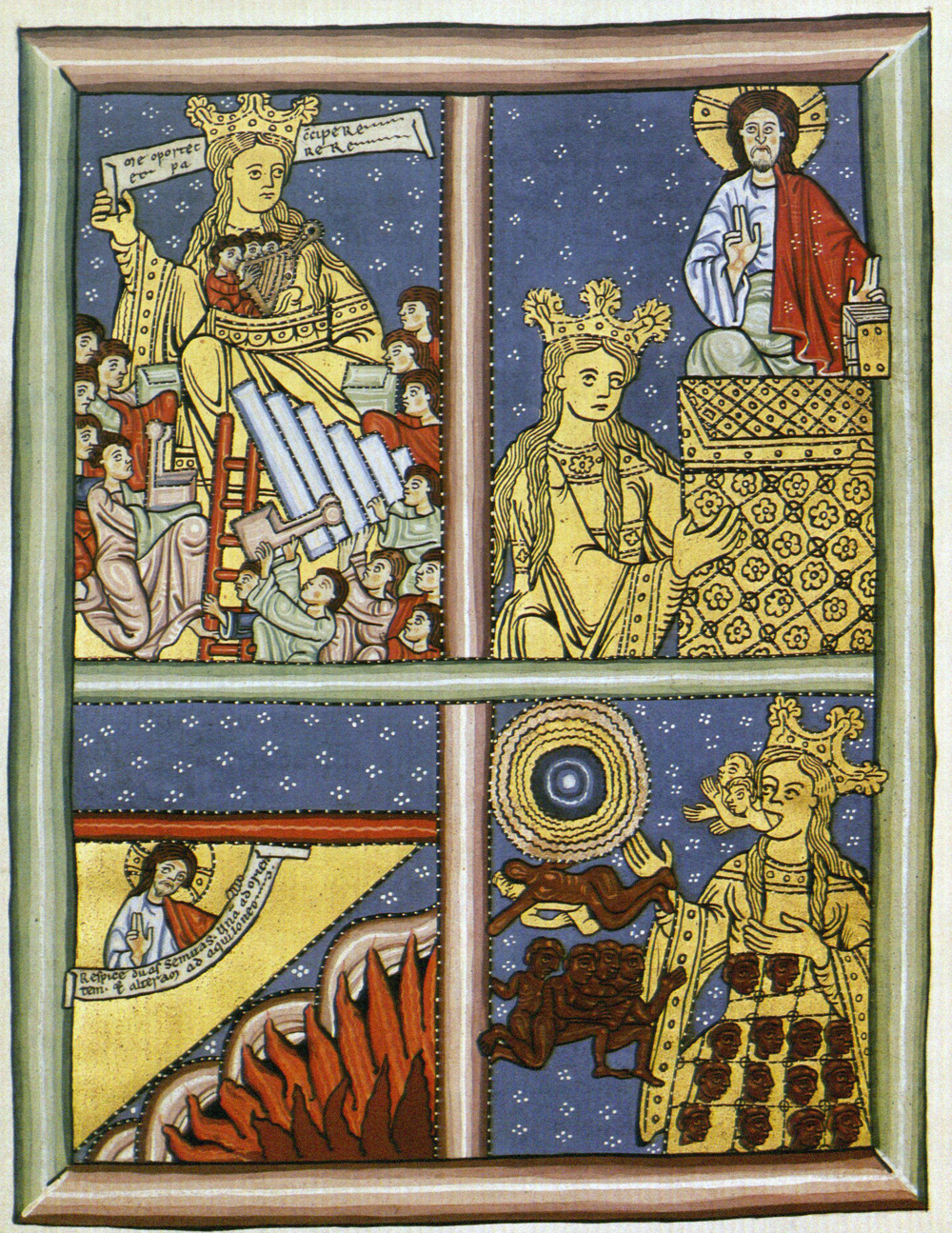
Another important image in Scivias is Ecclesia, the Church personified. Hildegard first portrays Ecclesia as the Bride of Christ and the Mother of Believers, who gives spiritual life through the work of the Holy Spirit and the sacraments. This image reflects the Church as a nurturing community where believers are formed and strengthened in faith.
As the visions progress, however, the image changes dramatically. Hildegard portrays Ecclesia as wounded, bruised, and burdened by corruption, while dark figures and the Antichrist appear around her. This striking contrast reminds readers that the Church exists in the tension between holiness and human weakness. Although the Church belongs to Christ, it continues to struggle against sin, corruption, and evil.
This image does more than describe the condition of the Church. It invites believers to examine their own participation in the life of the Church and their commitment to living faithfully. By visualizing both suffering and hope, Hildegard encourages readers to recognize that spiritual growth often develops through struggle. The image, therefore, becomes a call to perseverance, repentance, and hope as believers participate in God’s continuing work of renewal.
The Divine Light: Encountering God’s Presence

At the center of Hildegard’s visions is the image of the Lux Vivens, or Living Light. This divine light is more than a physical source of brightness; it represents God’s life-giving presence, filling creation and revealing divine truth. It is through this Living Light that Hildegard receives the command, “Write what you see and hear!” establishing a direct connection between divine revelation and her visionary experience.
The Living Light also symbolizes God’s wisdom and life actively working within creation. Through prayer and contemplation, believers are invited to dwell in this light until it transforms both their understanding and their lives. Rather than remaining distant observers, they become participants in God’s ongoing work of renewal.
Unlike ordinary illustrations, the images in Scivias are designed to support prayer, meditation, and worship. They encourage believers to slow down, reflect deeply, and allow the images to shape their relationship with God. As readers contemplate these sacred images, imagination, emotion, body, and spirit work together in the process of spiritual formation. In this way, the Living Light becomes not only the source of Hildegard’s visions but also a symbol of the transforming presence of God that continues to guide believers today.
Contemporary Relevance
Although Scivias was written in the twelfth century, its visual theology continues to offer valuable insights for Christian spirituality today. Hildegard’s work reminds modern believers that faith is not formed only through reading and intellectual study but also through imagination, contemplation, and visual experience. In a world where people are constantly surrounded by images, Scivias encourages Christians to think more carefully about how images can shape faith and draw people closer to God.
Modern society consumes an endless stream of digital images through social media, television, advertising, and artificial intelligence. While these images are often produced quickly and shared widely, they are usually designed to capture attention rather than encourage reflection. Scivias presents a different understanding of visual culture. Hildegard’s images were created as tools for prayer, meditation, and spiritual formation. They invite believers to slow down, contemplate, and encounter God’s presence rather than simply consume another image. In this way, Scivias challenges contemporary Christians to recover a more reflective and intentional use of sacred art.
Hildegard’s visual theology also reminds believers that spiritual formation involves the whole person. Her visions engage the mind, imagination, emotions, and body rather than appealing only to reason. David Morgan describes this relationship as the “reciprocal gaze,” where the viewer is not simply looking at an image but also experiences being seen by God. This understanding transforms sacred images from objects of observation into places of encounter. Prayer, worship, and contemplation become embodied experiences in which believers participate with both heart and mind.
Another important contribution of Scivias is its holistic understanding of creation. Hildegard’s concept of viriditas, or divine vitality, presents all creation as sustained by God’s life. This perspective continues to speak to contemporary Christians seeking a deeper connection among faith, creation, and environmental stewardship. Rather than separating the spiritual from the physical world, Hildegard teaches that God’s presence can be recognized throughout creation. Her theology encourages believers to care for the created world while seeing it as a reflection of God’s goodness.
Hildegard’s use of imagination also remains relevant today. Many Christians continue to use imaginative prayer and meditation to place themselves within biblical stories and deepen their relationship with God. In a similar way, the images in Scivias invite believers to move beyond simply reading about God’s work and instead imagine themselves participating in the story of salvation. Through this process, faith becomes more personal and transformative, engaging both understanding and experience.
Scivias offers valuable insights for an increasingly multicultural Church. Although Hildegard lived in medieval Europe, her images speak to a universal human desire to make the invisible realities of faith visible. Across different cultures, Christians have expressed their faith through art, architecture, music, icons, murals, and other visual traditions. These expressions differ from one community to another, yet they all demonstrate humanity’s desire to encounter God through visible forms. Hildegard’s work reminds contemporary believers that sacred images can communicate across cultures, inviting people from different backgrounds to reflect on God’s presence and participate in a shared spiritual journey.
Rather than belonging only to medieval history, Scivias continues to encourage Christians to recover the spiritual value of sacred images. In a culture that often values speed, efficiency, and constant consumption, Hildegard’s visual theology invites believers to slow down, contemplate God’s presence, and allow images to become instruments of worship, spiritual formation, and deeper communion with God.
Conclusion
This study has shown that the sacred images in Scivias are much more than artistic illustrations. Hildegard of Bingen used visual imagery as a form of theology, inviting believers to encounter God through contemplation, imagination, and embodied experience. Rather than separating faith from the senses, her visions bring together the mind, body, emotions, and spirit, demonstrating that Christian spirituality involves the whole person.
By examining the historical context of Hildegard’s life, the visual theology in Scivias, and selected images such as the Cosmic Egg, Ecclesia, and the Living Light, this paper shows how these images communicate theological truths that words alone cannot fully express. They reveal God’s relationship with creation, the Church’s mission, and the ongoing work of spiritual transformation. More importantly, they encourage believers not only to understand these truths intellectually but also to reflect on them through prayer, meditation, and imagination.
The study also demonstrates that Hildegard’s visual theology remains relevant for the contemporary Church. In a culture shaped by constant exposure to digital images, Scivias reminds Christians that images can serve a deeper purpose than entertainment or communication. When approached with prayer and contemplation, sacred images can become instruments of worship and spiritual formation, helping believers recognize God’s presence in their daily lives.
Hildegard’s work also challenges modern Christianity to recover a more holistic understanding of faith. While preaching, teaching, and theological study remain central to Christian life, visual imagination and contemplation also have an important place in spiritual formation. Recovering these practices does not replace Scripture or doctrine but complements them by engaging the whole person in the process of knowing God.
Scivias reminds us that seeing is more than a physical act. Sacred images have the power to shape imagination, deepen faith, and draw believers into a closer relationship with God. More than eight centuries after Hildegard first recorded her visions, her visual theology continues to invite Christians to see the ways of God with renewed imagination, deeper contemplation, and a faith that is both thoughtful and fully lived.
Sources / Bibliography
- Blessed Jutta of Disibodenberg. (n.d.). Blessed Jutta of Disibodenberg. Retrieved June 20, 2026, from https://faith.nd.edu/saint/blessed-jutta-of-disibodenberg/
- Camille, M. (1992). Image on the edge: The margins of medieval art. Harvard University Press.
- Foley, M. (2022). The Sibyl of the Rhine and the sacred liturgy. New Liturgical Movement. https://www.newliturgicalmovement.org/2022/09/the-sibyl-of-rhine-and-sacred-liturgy.html
- Hildegard of Bingen, & Hart, C. (1990). Scivias. Paulist Press.
- Hildegard of Bingen. (1995). Hildegard von Bingen’s mystical visions. Bear & Company.
- Kearney, R. (1988). The wake of imagination: Toward a postmodern culture. University of Minnesota Press.
- Kelsey, M. T. (1997). The other side of silence: Meditation for the twenty-first century. Paulist Press.
- Kosloski, P. (2023). St. Hildegard’s radically simple approach to church renewal. Aleteia. https://aleteia.org/2023/09/17/st-hildegards-radically-simple-approach-to-church-renewal/
- Morgan, D. (2012). The embodied eye: Religious visual culture and the social life of feeling. University of California Press.
- Newman, B. (1998). Voice of the living light: Hildegard of Bingen and her world. University of California Press.